


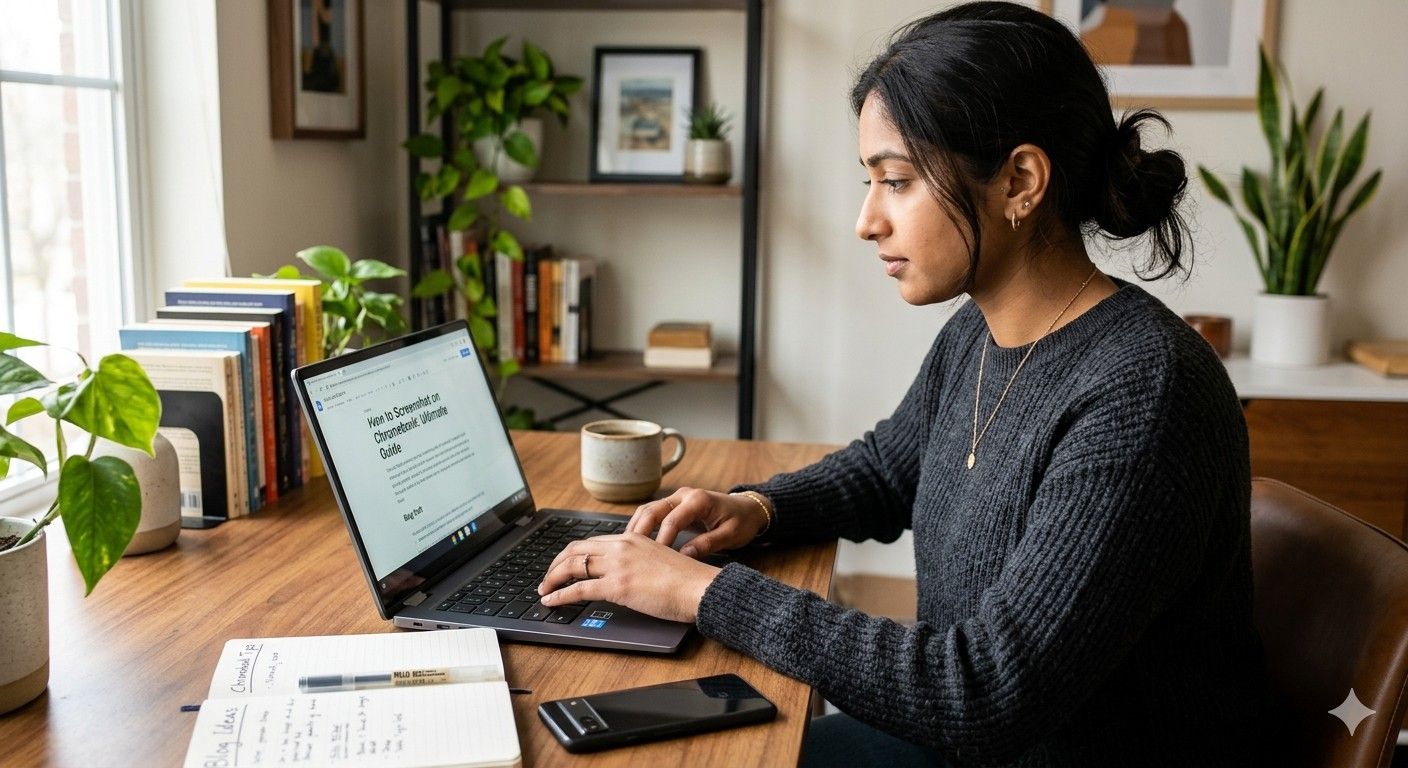
Switching to ChromeOS from Windows or macOS can feel like moving to a new country where everyone speaks a slightly different language. You know what you want to do, but the buttons aren’t where they used to be. One of the most common friction points for new users is figuring out how to screenshot on Chromebook devices without a traditional “Print Screen” key.
Whether you need to capture a receipt, save a snippet of a lecture, or share a glitch with tech support, capturing your screen is a vital daily task. Fortunately, Google has built an incredibly powerful suite of screen capture tools directly into ChromeOS.
This comprehensive guide will show you exactly how to screenshot on Chromebook laptops, tablets, and 2-in-1 devices. We will cover everything from classic keyboard shortcuts to the newer dedicated hardware keys and built-in screen recording tools.
The Master Key: Understanding the “Show Windows” Icon
Before diving into the shortcuts, you need to locate the most important key for capturing your screen on a Chromebook: the Show Windows key.
On a standard Chromebook keyboard, this key is located on the top row (usually the equivalent of the F5 key on a Windows PC). Its icon looks like a rectangle with two vertical lines on its right side. Some users also refer to it as the “Overview” or “Window Switcher” key.
Pro Tip for External Keyboards: If you are using a standard Windows or Mac keyboard plugged into your Chromebook, you won’t have this icon. Instead, use the F5 key to replace the Show Windows button.
How to Screenshot on Chromebook Using Keyboard Shortcuts
Keyboard shortcuts are the fastest, most efficient way to capture what is on your display. ChromeOS offers three distinct shortcut combinations depending on exactly how much of your screen you want to capture.
1. Capture Your Full Screen
If you want to snap an image of absolutely everything visible on your monitor, use this combination:
- Press Ctrl + Show Windows simultaneously.
As soon as you press these keys, you will see a brief notification in the bottom-right corner of your screen letting you know the image was successfully captured.
2. Capture a Partial Screen (Selected Area)
If you only need a specific paragraph, image, or section of a webpage, you don’t need to capture the whole screen and crop it later.
- Press Ctrl + Shift + Show Windows together.
Your cursor will instantly turn into a crosshair icon. Click and drag the crosshair across the exact area you want to save. Once you release your mouse trackpad, the partial screenshot is saved.
3. Capture a Specific Window
If you have multiple apps or browser windows open and only want to capture one specific application without background clutter:
- Press Ctrl + Alt + Show Windows.
ChromeOS will prompt you to click on the specific window you want to photograph. Move your cursor over the active application and click once to capture it cleanly.
Method 2: Using the ChromeOS Built-In Screen Capture Toolbar
If you struggle to remember multi-key shortcuts, Google provides a visual interface called the Screen Capture tool. This toolbar gives you clickable icons for all screenshot and screen recording functions.
+————————————————————-+
| [X] Camera [ ] Video | [Full] [Partial] [Window] [*] |
+————————————————————-+
How to Open the Screen Capture Toolbar
There are two incredibly easy ways to summon this visual menu:
- The New Hardware Key: Many modern Chromebook models now feature a dedicated Screenshot key right on the top row. It looks like a small circle inside a square icon. Pressing it opens the toolbar instantly.
- The Quick Settings Menu: Click on the time display in the bottom-right corner of your shelf (taskbar). In the Quick Settings grid that pops up, click on the icon labeled Screen Capture.
Navigating the Toolbar Options
Once the menu appears at the bottom of your screen, you can toggle between different modes:
- The Camera Icon: Sets the tool to take static screenshots.
- The Video Icon: Switches the tool into a screen recorder for video captures.
- Three Framing Boxes: Choose between Full Screen, Partial Screen, or Specific Window modes exactly like the shortcuts.
Method 3: How to Take a Screenshot on a Chromebook Tablet
If you are using a ChromeOS tablet (like the Lenovo IdeaPad Duet) or have your 2-in-1 Chromebook folded backward into tablet mode, your physical keyboard is disconnected or disabled.
To take a screenshot in tablet mode, use the physical hardware buttons on the side of the device:
- Press the Power Button + Volume Down Button at the same time.
This mirrors the exact action used to take a screenshot on Android smartphones and Apple iPads. Alternatively, you can always tap the clock in the bottom-right corner of the touch screen and select Screen Capture from the Quick Settings menu.
Where Do Screenshots Save on a Chromebook?
Unlike Windows or Mac, where screenshots might clutter your desktop, ChromeOS handles file management via local folders and the cloud.
The Downloads Folder (Default Location)
By default, every screenshot you take is saved as a .png file in your local storage. To find them:
- Open the Launcher (the circle icon in the bottom-left corner of your screen).
- Select the blue Files app icon.
- Click on My Files and then open the Downloads folder.
- Your captures will be organized by date and time.
The Quick-Access “Tote” Area
Look at your bottom shelf, right next to your clock. You will see a tiny preview area known as The Tote. This holds your most recent downloads and screenshots so you can drag and drop them directly into an email, Google Doc, or Discord message without opening the Files app.
Accessing the Clipboard History
Did you know ChromeOS copies every screenshot to your clipboard automatically? If you just need to paste the image directly into an app, simply press Ctrl + V.
If you want to view your last five copied items (including text and multiple images), press the Search Key + V (or Everything Key + V) to open your Clipboard Manager.
Advanced Feature: Changing Your Default Save Location
If your Chromebook is running low on local storage space, or if you prefer having your images instantly available across all your devices, you can change where files are saved.
- Open the Screen Capture toolbar (Shift + Ctrl + Show Windows).
- Click the Settings gear icon on the right side of the toolbar.
- Under the “Save to” menu, click Select folder.
- Choose a folder inside your Google Drive storage rather than local downloads.
Now, every image you snap will instantly upload to the cloud, saving local space and making it accessible from your phone or desktop computer.
How to Edit, Crop, and Annotate Your Screenshots
Once a screenshot is captured, a thumbnail preview will pop up briefly in the lower-right corner of your screen. Click on the Edit button within that notification bubble to access Google’s built-in image utility.
From this window, you can:
- Crop and Rotate: Trim away unnecessary parts of the image.
- Draw and Annotate: Select the pen tool to draw arrows, highlight text, or circle important pieces of data.
- Google Photos Integration: For advanced touch-ups, color balance, or filter adjustments, you can open the file directly in the Google Photos Android application right from your device.
Troubleshooting: Why Won’t My Chromebook Take a Screenshot?
If you are pressing the buttons and nothing is happening, don’t panic. Here are the most common solutions to fix screen capture issues:
- Outdated ChromeOS: The modern Screen Capture toolbar requires an updated operating system. Go to Settings > About ChromeOS > Check for updates to ensure your laptop is running the latest software version.
- Storage is Full: Local downloads will fail if your internal drive is full. Open your Files app to check available space, delete old downloads, or change your save location to Google Drive.
- Enterprise/School Restrictions: If your Chromebook was issued by a school district or employer, the administrator may have explicitly disabled screen capturing for security and privacy reasons (such as preventing cheating during exams). If this is the case, keyboard shortcuts will simply not respond.
Frequently Asked Questions (FAQs)
Can I take a scrolling screenshot on a Chromebook?
Native full-page scrolling screenshots are currently limited in the default ChromeOS toolset. To capture a long webpage from top to bottom, the best method is to use a highly rated Chrome Web Store extension like GoFullPage or Awesome Screenshot.
How do I take a screenshot on a Chromebook without the Show Windows key?
You can open the Quick Settings panel by clicking the clock in the bottom right corner of your screen and selecting the Screen Capture button. This opens the visual toolbar without requiring any special keyboard keys.
What is the Chromebook equivalent of the Snipping Tool?
The built-in Screen Capture toolbar (accessed via Shift + Ctrl + Show Windows) is the exact functional equivalent to Windows Snipping Tool or Mac’s Command+Shift+4 utility. It handles full screen, region select, and video recording cleanly.
Why do my screenshots turn black when capturing Netflix or Disney+?
This is a built-in security feature called DRM (Digital Rights Management). Streaming applications block screen capture software to prevent piracy and illegal distribution of copyrighted video content. There is no workaround for this on a standard Chromebook.
Conclusion
Learning how to screenshot on Chromebook devices is an essential skill that takes just a few moments to master but saves hours of frustration later. Whether you prefer using the rapid Ctrl + Show Windows shortcut or tapping through the visual Screen Capture tool, ChromeOS provides all the flexibility you need to capture, edit, and share your screen content.
Which method do you find easier to use? If you run into any weird layout bugs or have an external keyboard that won’t cooperate, drop a comment below and let us know what model you are using!
