


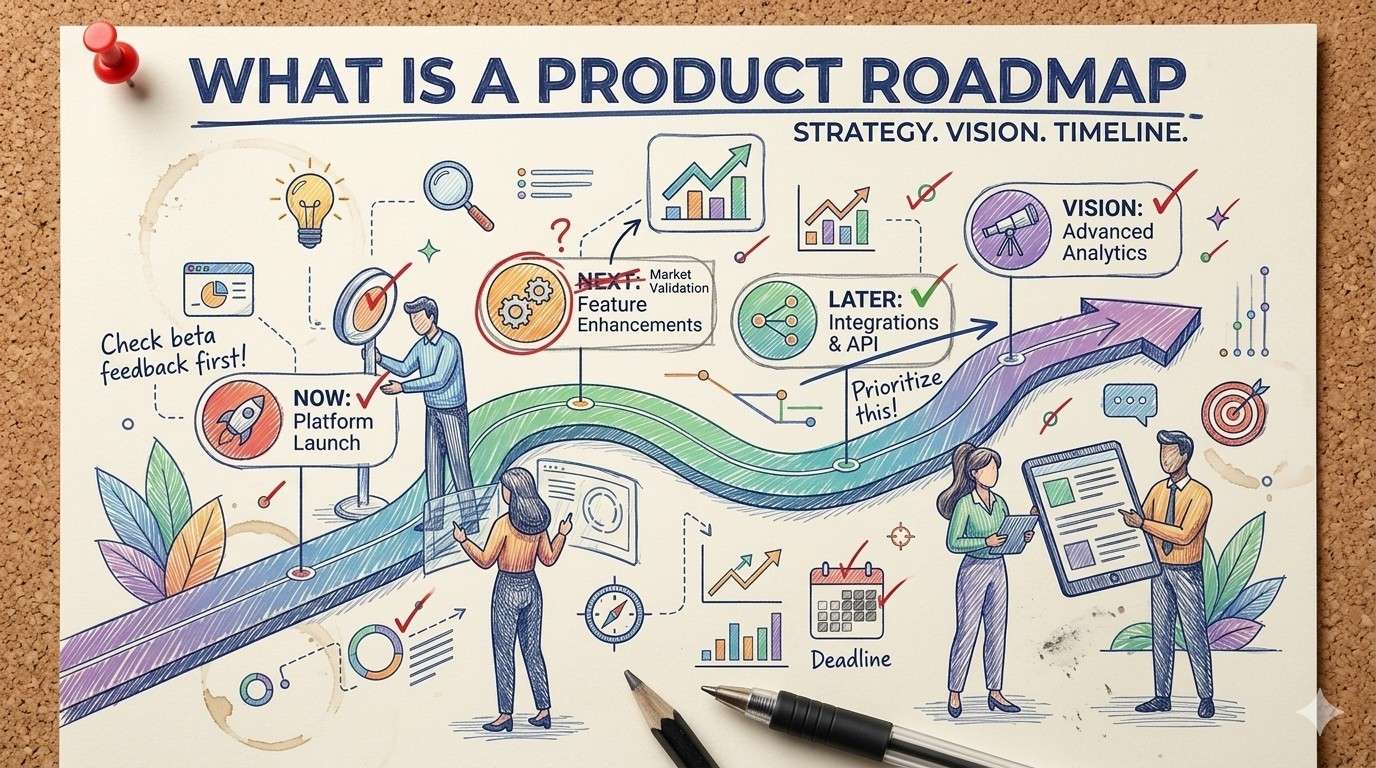
Building a successful product requires more than great ideas. Teams need a clear direction, shared priorities, and a plan that connects business goals with customer needs. This is where understanding what is a product roadmap becomes essential.
A product roadmap is a strategic document that outlines the vision, direction, priorities, and progress of a product over time. It serves as a communication tool that helps product managers, stakeholders, developers, marketers, and executives align around common objectives.
Whether you’re launching a new software platform, improving an existing application, or managing a complex product portfolio, a well-designed roadmap helps transform ideas into measurable results.
In this guide, you’ll learn what a product roadmap is, why it matters, different roadmap types, how to create one, common mistakes to avoid, and practical examples that modern teams use in 2025.
Why Product Roadmaps Matter in Modern Product Management
Today’s businesses operate in highly competitive markets where customer expectations change quickly. Without a roadmap, teams often struggle with shifting priorities, missed deadlines, and unclear objectives.
A product roadmap helps organizations:
- Align teams around shared goals
- Prioritize features effectively
- Communicate strategy to stakeholders
- Improve decision-making
- Manage resources efficiently
- Track product progress
- Focus on customer value
Instead of asking, “What should we build next?” teams can use a roadmap to answer, “What should we build to achieve our strategic goals?”
What Is a Product Roadmap in Simple Terms?
Think of a product roadmap as a high-level blueprint for your product’s future.
It doesn’t contain every technical detail. Instead, it shows:
- Product vision
- Business objectives
- Key initiatives
- Major features
- Timelines or themes
- Expected outcomes
A roadmap provides context behind development decisions rather than simply listing tasks.
Product Roadmap Definition
A product roadmap is a strategic planning tool that communicates the planned evolution of a product, including goals, priorities, and initiatives designed to deliver value to customers and the business.
Key Components of a Product Roadmap
Every effective roadmap includes several essential elements.
1. Product Vision
The product vision defines the long-term purpose of the product.
Examples include:
- Becoming the leading project management platform
- Simplifying online learning experiences
- Improving financial accessibility
The roadmap should always support this vision.
2. Strategic Goals
Goals provide measurable targets that guide roadmap decisions.
Examples:
- Increase customer retention by 20%
- Improve user engagement
- Expand into new markets
- Reduce churn rates
3. Product Initiatives
Initiatives are larger themes or focus areas.
Examples:
- Mobile app improvements
- AI-powered automation
- Security enhancements
- Customer onboarding optimization
4. Features and Deliverables
Features represent specific solutions that support initiatives and goals.
Examples:
- User dashboards
- Payment integrations
- Reporting tools
- Chat functionality
5. Timeline or Time Horizons
Roadmaps often organize work into:
- Short-term priorities
- Mid-term initiatives
- Long-term opportunities
This structure keeps plans flexible while maintaining direction.
Types of Product Roadmaps
Not all roadmaps serve the same purpose. Different audiences require different roadmap formats.
Strategic Product Roadmap
A strategic roadmap focuses on long-term objectives rather than individual features.
Best for:
- Executives
- Investors
- Leadership teams
Benefits:
- Aligns product strategy with business goals
- Supports high-level decision-making
Feature-Based Roadmap
This roadmap highlights upcoming features and releases.
Best for:
- Customers
- Sales teams
- Customer success teams
Benefits:
- Provides visibility into future enhancements
- Helps manage customer expectations
Agile Product Roadmap
Agile roadmaps focus on outcomes rather than fixed deliverables.
Best for:
- Agile development teams
- Scrum organizations
Benefits:
- Greater flexibility
- Faster adaptation to market changes
Technology Roadmap
A technology roadmap focuses on infrastructure improvements and technical investments.
Examples:
- Cloud migration
- Security upgrades
- Platform modernization
Portfolio Roadmap
Large organizations often manage multiple products simultaneously.
A portfolio roadmap provides visibility across all product initiatives.
Product Roadmap vs Product Backlog
Many people confuse roadmaps and backlogs, but they serve different purposes.
| Product Roadmap | Product Backlog |
| Strategic | Tactical |
| Focuses on goals | Focuses on tasks |
| Long-term planning | Short-term execution |
| Used by stakeholders | Used by development teams |
| Shows direction | Shows implementation details |
The roadmap explains why work matters.
The backlog explains what work needs to be completed.
How to Create a Product Roadmap
Understanding what a product roadmap is is only the first step. Creating one effectively requires a structured process.
Step 1: Define Your Product Vision
Start by answering:
- What problem are we solving?
- Who are we helping?
- What long-term value will we provide?
A clear vision acts as the foundation for every roadmap decision.
Step 2: Understand Customer Needs
Gather insights through:
- Customer interviews
- Surveys
- Analytics data
- Support tickets
- Market research
The strongest roadmaps are built around real customer problems.
Step 3: Establish Strategic Objectives
Objectives should be measurable and aligned with business outcomes.
Examples:
- Increase monthly active users
- Improve conversion rates
- Expand enterprise adoption
Step 4: Prioritize Initiatives
Not every idea deserves immediate attention.
Popular prioritization frameworks include:
- RICE (Reach, Impact, Confidence, Effort)
- MoSCoW Method
- Value vs Effort Matrix
- Kano Model
These frameworks help teams make objective decisions.
Step 5: Organize Initiatives into Themes
Group related work under larger strategic themes.
Examples:
- Customer Experience
- Automation
- Security
- Scalability
Themes make roadmaps easier to understand.
Step 6: Communicate and Share
A roadmap only works if people understand it.
Share it with:
- Leadership
- Product teams
- Engineering
- Marketing
- Sales
- Customer success
Regular communication ensures alignment.
Product Roadmap Example
Imagine a SaaS project management platform.
Q1: User Experience Improvements
- New dashboard design
- Faster navigation
- Mobile optimization
Q2: Collaboration Features
- Real-time editing
- Team workspaces
- Shared templates
Q3: Automation Tools
- Workflow automation
- AI task suggestions
- Smart notifications
Q4: Enterprise Expansion
- Advanced security controls
- Single sign-on
- Custom reporting
This roadmap focuses on strategic themes while remaining flexible enough for adjustments.
Benefits of a Product Roadmap
Organizations that maintain effective roadmaps often experience stronger alignment and better product outcomes.
Improved Team Alignment
Everyone understands priorities and objectives.
Better Resource Allocation
Teams invest effort where it creates the most value.
Increased Stakeholder Confidence
Roadmaps provide transparency into plans.
Faster Decision-Making
Clear priorities reduce uncertainty.
Customer-Centric Development
Roadmaps help teams focus on solving real user problems.
Enhanced Strategic Planning
Product decisions become tied to measurable business goals.
Common Product Roadmap Mistakes to Avoid
Even experienced teams make roadmap mistakes.
Treating the Roadmap as a Fixed Contract
Markets change.
Customer needs evolve.
Roadmaps should remain flexible.
Focusing Only on Features
Customers care about outcomes, not feature lists.
Focus on solving problems rather than shipping functionality.
Ignoring Customer Feedback
Roadmaps should reflect actual customer needs.
Without feedback, teams risk building low-value features.
Overloading the Roadmap
Too many initiatives create confusion and reduce execution quality.
Prioritize ruthlessly.
Lack of Stakeholder Communication
A roadmap hidden from stakeholders loses much of its value.
Keep communication ongoing.
Product Roadmap Best Practices for 2025
Modern product teams are adopting new approaches to roadmap planning.
Focus on Outcomes
Instead of promising features, define desired business outcomes.
Use Data-Driven Decisions
Leverage:
- Product analytics
- Customer behavior data
- Market trends
- User feedback
Review Regularly
Most successful teams review roadmaps monthly or quarterly.
Balance Short-Term and Long-Term Goals
Quick wins matter, but long-term innovation remains essential.
Keep Roadmaps Simple
Complex roadmaps are harder to understand and maintain.
Clarity improves adoption.
Frequently Asked Questions
What is a product roadmap used for?
A product roadmap is used to communicate product strategy, priorities, goals, and planned initiatives. It helps align stakeholders and guide product development efforts.
Who creates a product roadmap?
Typically, product managers create and maintain product roadmaps. However, they often collaborate with executives, developers, designers, marketers, and customers.
What should a product roadmap include?
A product roadmap should include the product vision, strategic objectives, key initiatives, major features, priorities, and expected outcomes.
How often should a product roadmap be updated?
Most organizations review and update roadmaps monthly or quarterly to reflect changing business needs and customer feedback.
Is a product roadmap the same as a project plan?
No. A product roadmap focuses on strategic direction and long-term goals, while a project plan contains detailed tasks, deadlines, and execution requirements.
What tools are used to create product roadmaps?
Popular roadmap tools include dedicated product management platforms, project management software, spreadsheets, and visual planning applications.
Conclusion
Understanding what a product roadmap is is essential for anyone involved in product development, strategy, or business growth. A product roadmap acts as a strategic guide that connects customer needs, business objectives, and development priorities into a single, understandable plan.
The most effective roadmaps do more than list features. They communicate vision, align teams, support decision-making, and help organizations deliver meaningful outcomes. As product management continues to evolve in 2025 and beyond, companies that focus on outcome-driven, customer-centric roadmapping will be better positioned to innovate and compete.
Whether you’re a startup founder, product manager, executive, or development leader, investing time in creating a clear and flexible product roadmap can significantly improve your product’s chances of long-term success.
