


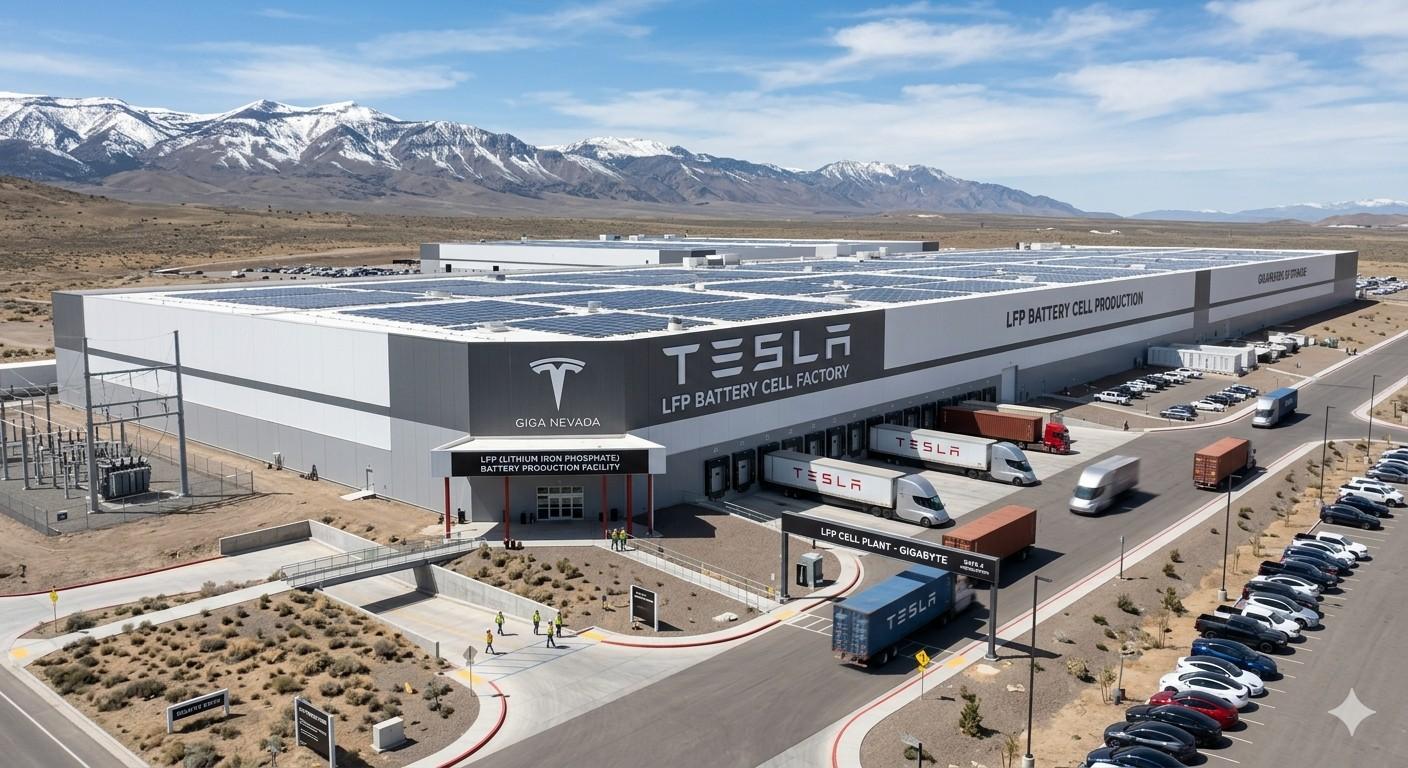
The Tesla LFP battery factory Nevada is becoming one of the most important developments in the American battery industry. As Tesla continues expanding beyond electric vehicles into large-scale energy storage, the company is investing heavily in domestic battery production to reduce dependence on overseas suppliers.
Located near Tesla’s existing Gigafactory in Sparks, Nevada, the new facility focuses on manufacturing lithium iron phosphate (LFP) battery cells. These batteries are expected to power Tesla’s growing lineup of energy storage products, including Megapack and Powerwall systems.
For years, Tesla relied heavily on imported LFP batteries from China. The new Nevada factory changes that strategy by bringing production closer to home, improving supply chain resilience, lowering costs, and supporting growing demand for renewable energy storage solutions.
What Is the Tesla LFP Battery Factory Nevada Project?
The Tesla LFP battery factory Nevada is Tesla’s first large-scale North American facility dedicated to producing lithium iron phosphate battery cells.
The plant sits adjacent to Gigafactory Nevada in Sparks and is designed to support Tesla’s rapidly expanding energy business. Unlike Tesla’s 4680 battery production efforts that primarily target electric vehicles, this facility focuses heavily on stationary energy storage applications.
Key Highlights
- Located in Sparks, Nevada
- Adjacent to Gigafactory Nevada
- Initial capacity estimated at 10 GWh annually
- Focused on LFP battery production
- Primarily intended for Megapack and Powerwall products
- Supports Tesla’s U.S. supply chain localization strategy
Industry reports suggest the facility began nearing completion during 2025 and entered early production stages during 2026.
Why Tesla Is Investing in LFP Battery Technology
LFP batteries have become increasingly popular across the EV and energy storage industries.
Unlike nickel-based battery chemistries, LFP batteries use lithium iron phosphate as the cathode material. This provides several advantages.
Benefits of LFP Batteries
Longer Lifespan
LFP batteries can withstand more charging and discharging cycles compared to many nickel-based alternatives.
Improved Safety
The chemistry is more thermally stable, reducing fire risks and improving overall safety.
Lower Production Costs
Iron and phosphate are generally cheaper and more abundant than nickel and cobalt.
Better for Energy Storage
Grid storage systems require durability and long-term performance more than maximum energy density.
These advantages make LFP batteries ideal for Tesla’s energy products.
How the Nevada Factory Supports Tesla Energy Growth
Tesla’s energy division has become one of the company’s fastest-growing business segments.
As demand for renewable energy grows worldwide, utilities increasingly need large battery storage systems to balance electricity supply and demand.
The Rise of Megapack
Tesla’s Megapack systems help:
- Store solar energy
- Support power grids
- Prevent blackouts
- Stabilize renewable energy generation
- Reduce reliance on fossil fuel peaker plants
Recent reports indicate Tesla deployed nearly 10 GWh of energy storage during a single quarter, highlighting the massive demand for battery storage solutions.
The Tesla LFP battery factory Nevada is expected to provide a reliable domestic supply of cells specifically for these applications.
Tesla’s Shift Away From Imported LFP Batteries
Before this project, Tesla sourced nearly all of its LFP cells from Chinese manufacturers.
This created several challenges:
- Supply chain disruptions
- Shipping delays
- Rising geopolitical tensions
- Import tariffs
- Limited control over production capacity
By manufacturing LFP cells in Nevada, Tesla gains greater control over its battery supply chain while reducing exposure to international trade risks.
Domestic Manufacturing Advantages
The Nevada facility helps Tesla:
- Improve supply chain security
- Reduce transportation costs
- Increase production flexibility
- Qualify for U.S. manufacturing incentives
- Expand energy storage production faster
These advantages could significantly strengthen Tesla’s position in the global energy market.
Tesla and CATL: A Strategic Partnership
One of the most discussed aspects of the Tesla LFP battery factory Nevada is Tesla’s reported collaboration with CATL.
CATL is currently the world’s largest battery manufacturer and a global leader in LFP battery technology.
Industry sources indicate Tesla acquired manufacturing equipment and production expertise connected to CATL’s proven LFP manufacturing methods.
Why This Partnership Matters
Instead of developing every manufacturing process from scratch, Tesla appears to be leveraging mature battery production technology.
This strategy may help:
- Accelerate production timelines
- Reduce development risks
- Improve battery quality
- Increase manufacturing efficiency
For Tesla, speed to market is critical as energy storage demand continues to rise worldwide.
Production Capacity and Expansion Plans
Most reports estimate the factory will launch with approximately 10 GWh of annual production capacity.
To put that into perspective:
- 10 GWh equals 10 billion watt-hours of storage capacity.
- It can support large-scale Megapack deployments.
- Capacity could expand significantly over time.
Future Growth Potential
Tesla has a history of scaling production rapidly once facilities become operational.
Analysts expect future expansions to include:
- Additional production lines
- Higher battery output
- Advanced battery manufacturing technologies
- Potential support for future vehicle applications
The Nevada site already serves as one of Tesla’s most important manufacturing hubs, making expansion relatively straightforward.
Could These Batteries Eventually Power Tesla Vehicles?
Currently, most reports suggest the Nevada LFP factory focuses on energy storage products rather than passenger vehicles.
However, many industry experts believe vehicle applications could eventually follow.
Possible Future Vehicle Uses
LFP batteries are increasingly common in:
- Standard-range EVs
- Fleet vehicles
- Commercial vans
- Robotaxis
- Entry-level electric cars
Tesla already uses LFP batteries in certain vehicle models outside North America, making future integration a realistic possibility.
As battery production expands domestically, Tesla may gain greater flexibility in how it deploys these cells across its product lineup.
Economic Impact of the Nevada Battery Factory
The Tesla LFP battery factory Nevada is expected to create substantial economic benefits.
Regional Benefits
The project may generate:
- Manufacturing jobs
- Engineering positions
- Construction opportunities
- Supplier partnerships
- Infrastructure investment
Nevada has already become one of America’s leading battery manufacturing centers, and Tesla’s continued expansion strengthens that position.
National Benefits
For the United States, domestic LFP production helps:
- Reduce reliance on foreign battery imports
- Strengthen clean energy infrastructure
- Support renewable energy goals
- Improve energy security
These factors make the project strategically important beyond Tesla itself.
Challenges Facing the Tesla LFP Battery Factory Nevada
Despite its promise, the project faces several challenges.
Supply Chain Complexity
Battery manufacturing requires access to:
- Lithium
- Phosphate
- Iron
- Processing equipment
- Specialized labor
Building a fully domestic battery ecosystem remains a long-term challenge.
Competition
Tesla also faces increasing competition from:
- CATL
- BYD
- LG Energy Solution
- Panasonic
- Samsung SDI
Many competitors are expanding their own North American battery manufacturing operations.
Technology Evolution
Battery technology continues to evolve rapidly.
Future alternatives such as sodium-ion batteries could eventually reshape parts of the energy storage market, requiring manufacturers to adapt.
How the Factory Fits Into Tesla’s Long-Term Vision
Tesla’s long-term strategy extends far beyond electric vehicles.
The company increasingly positions itself as:
- An energy company
- A battery manufacturer
- A grid infrastructure provider
- A renewable energy leader
The Tesla LFP battery factory in Nevada plays a central role in that vision.
By controlling battery production, Tesla can better support:
- Solar energy adoption
- Grid-scale storage
- Residential energy independence
- Large commercial energy projects
As renewable energy installations increase worldwide, battery storage becomes an essential part of the energy transition.
FAQs About Tesla LFP Battery Factory in Nevada
Where is the Tesla LFP battery factory located?
The facility is located in Sparks, Nevada, adjacent to Tesla’s existing Gigafactory Nevada campus.
What does LFP stand for?
LFP stands for Lithium Iron Phosphate, a battery chemistry known for safety, durability, and lower production costs.
What products will use these batteries?
Current reports indicate the batteries will primarily support Tesla Megapack and Powerwall energy storage products.
How much battery capacity will the factory produce?
Industry estimates place initial annual production at approximately 10 GWh.
Is Tesla working with CATL?
Reports suggest Tesla is utilizing manufacturing equipment and expertise associated with CATL’s LFP battery production technology.
Will Tesla use Nevada-made LFP batteries in vehicles?
Currently, the factory appears focused on energy storage products, though future vehicle applications remain possible.
Conclusion
The Tesla LFP battery factory Nevada represents a major step forward for both Tesla and the American battery industry. By bringing LFP battery production to the United States, Tesla reduces dependence on imported cells, strengthens its supply chain, and supports the rapid expansion of its energy storage business.
With an estimated annual capacity of 10 GWh, strong demand from Megapack deployments, and growing interest in renewable energy infrastructure, the Nevada facility could become one of the most influential battery manufacturing projects in North America.
As Tesla continues to scale energy storage alongside electric vehicle production, the success of the Tesla LFP battery factory in Nevada may help shape the next generation of battery manufacturing and clean energy deployment across the globe.
